
Journal

Most managers are promoted for what they did before, not their ability to lead. Research from the Chartered Management Institute puts the number entering the role with no formal training at 82%. Here is why that gap persists, and why coaching closes it.

The short answer: human coaching and technology-enabled coaching are not in competition. Human coaching offers depth, nuance, and relational connection that no platform can replicate. A quality coaching platform fills a critical gap, making coaching accessible to the managers who need it most but have never had access to it. Used together, they build stronger leaders at every level of an organisation.

Imposter syndrome is common for new managers and is not a sign that you were the wrong choice for the role. It tends to surface at the point of promotion because the role genuinely is different from what you were doing before. Recognising it, understanding what is driving it, and knowing how to deal with it are what help most. Seeking support through coaching, reflection, or a trusted sounding board is not a sign of weakness. It is one of the most effective things a new manager can do.

The hardest turn in an AI coaching conversation is the last one. Get it right and the coachee walks away with something specific. Get it wrong and they leave with a vague good feeling and no change. Our research found AI coaches get it wrong in more than 85% of real coaching sessions. The reason isn't intelligence. The AI is trained to be helpful. Helpful and closing pull against each other, and the training wins. We call it maintenance bias: the model keeps the conversation going past the point where it's ready to land. A general-purpose LLM doesn't want to end a chat. An AI coach has to.
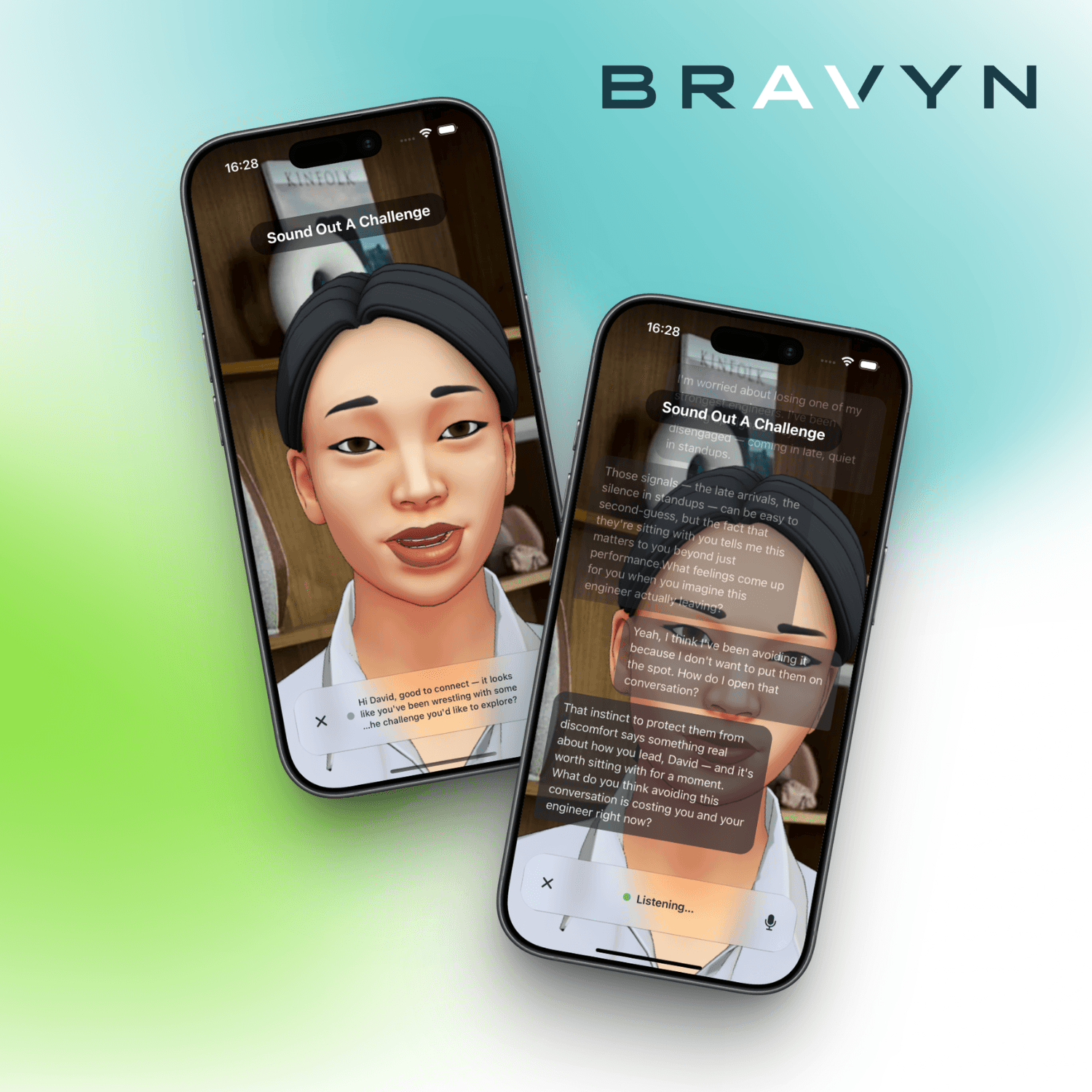
Coaching isn't what you say to someone. It's what happens because someone is there. Until now AI has been able to ask coaching questions through a chat box. It still hasn't been able to be present in the room. This piece is about what we built and why we built it that way: an emotionally expressive avatar called Victoria, full-screen on a phone. Coaching is sustained attention. A face is the most direct way to give it.

Embracing change isn't a personality trait, it's a learnable skill, and most managers find it harder than they expect. This piece looks at why managers struggle, the limiting beliefs that get in the way, and why resilience is the foundation the whole thing rests on.

A coaching leadership style develops your team through questions, reflection and supported problem-solving rather than direction and instruction. This piece covers what it actually is, why it matters now, and how to start building it as a daily practice.

Good leadership habits do not form by accident. They require intention, a clear starting point, and an environment that makes the desired behaviour easier than the default one. For managers, the habits that matter most are the ones that get squeezed out first when pressure increases. The structured one-to-one. The few minutes of reflection at the end of the day. The deliberate pause before reacting. Building these takes effort initially, but once embedded, they do more for your development than almost any training programme.
BOOK A DEMO